

Read Time: 8 Minutes
Most organizations come to grants with a familiar story: a big opportunity appears, the deadline is tight, and everyone scrambles to pull together budgets, registrations, and impact data in time to hit “submit.”
Sometimes you make it.
Sometimes you miss the deadline by a day.
Sometimes you submit, only to realize later you were never truly eligible.
Underneath all of that stress is a single issue: grant readiness.
Grant readiness is your organization’s capability and capacity to:
Being “grant ready” does not mean you have perfected the art of grant writing or that you have a color‑coded list of every grant that will ever exist.
It means you have enough structure, information, and systems in place that, when the right opportunity appears, you can move quickly and confidently.
What Grant Readiness Really Means

If you had to explain grant readiness to a board member or a volunteer, you might say:
Grant readiness is how prepared we are behind the scenes to apply for, receive, and manage grants without putting the organization at risk.
Funders look for readiness before they ever fall in love with your narrative. They scan for:
- Basic eligibility
- Legal and financial compliance
- Evidence you can deliver what you are proposing
When those pieces are missing, it does not matter how beautiful your storytelling is. Your proposal may never make it past the first screen.
Why Grant Readiness Comes Before Grant Writing
In our client work, we start with nonprofit grant readiness for a reason:
- Funders often check eligibility and capacity before they read anything else.
- Missing registrations, unfiled 990s, or weak financial systems can disqualify you immediately.
- Organizations that invest in readiness are more likely to secure funding because they can respond quickly with complete, credible documentation.
Think about your own experience:
- Have you ever rushed to submit a grant and discovered at the last minute that you were missing a required document?
- Realized after the fact that you were never actually eligible?
- Struggled to answer basic questions about your budget, program data, or outcomes?
Those moments are not personal failures. They are symptoms of a system problem.
The Real Cost of Skipping Readiness
Skipping readiness and jumping straight into applications has a price tag.
1. Automatic disqualification
- Lapsed or missing 501(c)(3) status or charitable registration
- Unfiled or late Form 990s
- Required audits or financial statements that do not exist
These issues can knock you out of the running before anyone reads your “case for support.”
2. Last‑minute chaos
- No clear, approved organizational budget
- Program budgets that do not match what the narrative promises
- No reliable way to show who you serve or what results you are getting
This is where teams end up digging through old emails, guessing at numbers, or copying language from past proposals that may no longer be true.
3. Long‑term consequences
- Lost trust and credibility with funders
- Burnout for staff and volunteers
- Time and money spent on proposals that were never truly competitive
Grant writing looks exhausting from the outside because many organizations are trying to build the airplane mid‑flight. Grant readiness is what lets you build the runway first.
The Runner Metaphor: Train Before You Race

You would never ask a runner to complete a race without preparing. A serious runner:
- Buys the right shoes
- Puts on the uniform
- Warms up their body
- Previews the route
- Trains consistently before race day
Grant readiness is your organization’s training and warm‑up.
-
Legal registrations are your shoes.
You cannot get on the track without them.
-
Financial systems and budgets are your warm‑up.
If those muscles are cold, you get hurt later in reporting, audits, or compliance.
-
Program documentation and data are your route preview.
You know where you are going and what success looks like.
-
Organizational capacity and governance are your training plan.
You have the stamina to deliver what you promise.
Ask yourself:
- Where do we feel most prepared today: shoes, warm‑up, route preview, or training plan?
- Where do we feel least prepared, and what are the consequences if that area stays weak?
You do not have to fix everything at once. You just need to know where you are on the track.
Grant Readiness Checklist: A Quick Self‑Assessment
Use these questions as an honest snapshot of where you are today. You do not need a perfect score to move forward. The goal is clarity, not judgment.
1. Legal and compliance
- Do we have current 501(c)(3) (or relevant) status and state charitable registrations?
- Are our last three years of Form 990s filed and easy to access?
2. Financial systems
- Do we have a current, board‑approved organizational budget?
- Can we quickly pull basic financial reports (income, expenses, balance sheet)?
- Do we clearly track restricted vs. unrestricted funds?
3. Program and impact data
- Can we clearly state who we serve, how many people we serve, and what changes we are seeing?
- Do we have at least one to two years of basic program data or, if we are newer, a plan for tracking it?
4. Organizational capacity
- Do we have an engaged board and clear leadership structure?
- Do we have at least one person with time and skills to manage grants after they are awarded (not just write them)?
5. Documentation and systems
- Are our key documents (bylaws, policies, budgets, program descriptions, reports) organized and easy to find?
- If a funder asked for a standard packet of documents today, could we assemble it within a week?
This is your starting line. Not a verdict.
Choosing Your First Grant Readiness Quick Win
Once you have an honest picture, choose one next move that will make everything easier.
Examples of quick wins you can complete in the next 30 days:
- File a missing registration or bring a lapsed status current
- Draft or update a basic organizational budget and have the board approve it
- Create one shared folder for your standard grant documents
- Start a simple spreadsheet or Notion database to track program numbers consistently
Pick one gap that feels both urgent and doable.
Ask:
- What small step would reduce the most friction the next time we see a promising grant?
- Who needs to be involved: staff, board, volunteers, or outside help?
Grant readiness is not about being perfect. It is about being clear.
When you know exactly where you are strong and where you have gaps, every future grant decision becomes faster, more strategic, and less stressful.
Your Next Step (20 Minutes This Week)
- Answer the self‑assessment questions honestly.
- Circle your top three gaps.
- Choose one quick win you can complete in the next 30 days.
That single act of clarity will do more for your long‑term grant success than another rushed, last‑minute proposal.
Ready to Build a Complete Grant Readiness Foundation?
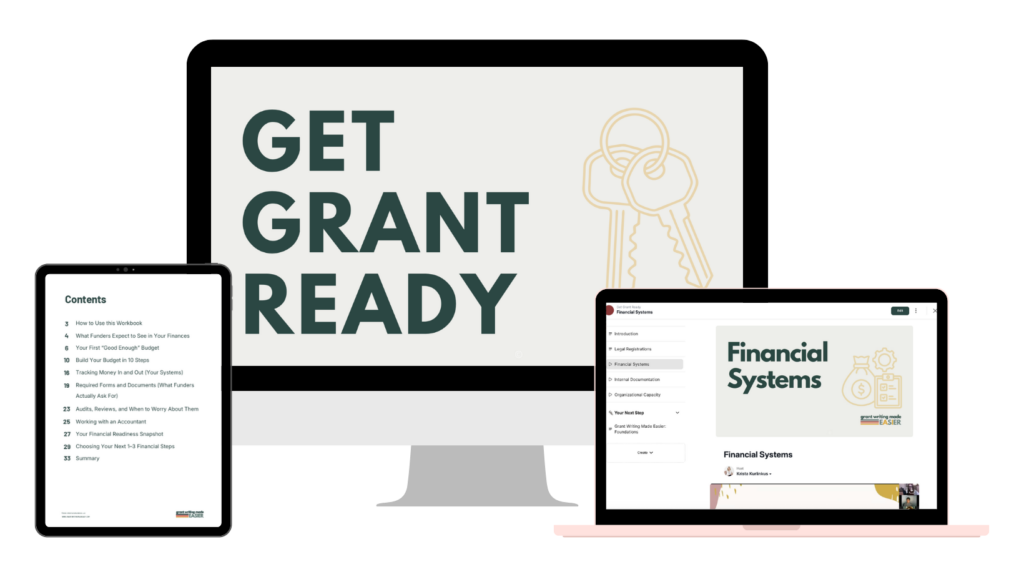
If the self‑assessment above revealed gaps you want to address systematically, our Grant Readiness course walks you through every step of building a solid foundation for grant success.
Over five comprehensive lessons, you will:
1. Introduction to Grant Readiness
Define what grant readiness means for your organization
-
- Identify your top capacity gaps
-
- Choose realistic quick wins you can complete in 30 days
2. Legal Registrations
-
- Determine your entity type and registration requirements
-
- Complete or update core registrations (EIN, 501(c)(3), state registrations, SAM.gov)
-
- Build a compliance calendar to stay current year‑round
3. Financial Systems & Materials
-
- Create your first “good enough” organizational budget
-
- Set up simple systems to track money in and out
-
- Gather the financial documents funders actually request
4. Internal Documentation
-
- Build your organizational snapshot and board materials
-
- Develop core personnel policies
-
- Create grant‑ready staff bios, organizational charts, and narrative materials
5. Organizational Capacity
-
- Assess your operational, leadership, management, and adaptive capacity
-
- Set SMART capacity‑building goals
-
- Create a realistic 90‑day action plan
Each lesson includes a workbook with:
-
- Step‑by‑step guidance and templates
-
- Simple checklists to track your progress
-
- Reflection prompts to help you make strategic decisions
-
- Real examples and practical scripts
The course is designed for busy nonprofit leaders who want to stop guessing and start building a grant practice on a solid foundation.
Learn more about our Grant Readiness course →
FAQ: Grant Readiness
What is grant readiness?
Grant readiness is how prepared your organization is to apply for, receive, and manage grants responsibly. It includes compliance, financial systems, program data, and the ability to report on funds after an award.
Is grant readiness the same as grant writing?
No. Grant writing is constructing the application itself. Grant readiness is the infrastructure that makes your application credible to funders and then makes post‑award management possible.
What documents do funders commonly ask for?
Many funders request proof of nonprofit status in the form of an IRS letter, recent Form 990s, budgets or financial statements, and basic program information. Requirements vary, but being able to assemble a standard document packet quickly is a strong signal of capacity.





Leave a Comment