Ever skim the headlines and wonder, “Is AI coming for my grant writing job?” You’re not alone. In recent months, the conversation around artificial intelligence (AI) has taken a dramatic turn. While the criticism and concerns over some aspects of AI—including environmental impacts and severe ethical and human rights violations—are entirely valid, today we’re zooming in on AI and grant writing. Some grant writers fear that automation will replace human roles, while others herald it as a new era of productivity. However, at Grant Writing Made Easier, we see a different story: AI as a powerful collaborator that amplifies your expertise, rather than a threat.
We’re here to debunk the top AI myths, explore how ethical AI grant writing tools can boost your efficiency, and discuss why AI-driven grant strategy is the future of grant readiness. You’ll come away with practical tips to win more grants while working less, and a clear path to integrating ethical, practical AI usage into your process.
Myth #1: AI Will Fully Automate Grant Writing
This myth gets at the heart of the fear: if AI can write for me, do I even matter?
Short answer: Yes. Immensely.
Long answer: Language models can help draft, format, and even analyze. However, they lack context, critical thinking, and program expertise. AI doesn’t know your funder relationships, your community’s lived experience, or how one program connects to a broader movement. But what it can do is create a powerful starting point. Not starting from scratch every single time saves you hours while freeing your brain for strategy and nuance.
If you’ve ever stared at a blank screen thinking, “I don’t have it in me to start this again,” AI is your co-writer, not your replacement. With the proper infrastructure in place, your AI tools become significantly more effective. The AI Grants Hub™ integrates your core narratives, past proposals, and data. With that foundation, AI-generated drafts become smarter and more accurate over time. You, the human, are doing all the thinking. AI does the typing.
Myth #2: Using AI Will Make Your Proposals Lack Authenticity and Human Empathy
Another real fear: “If everyone uses AI, won’t all proposals start to sound the same?”
Only if everyone starts with the same inputs.
The truth is, AI will reflect the quality and uniqueness of the information you feed it. If you ask it to “write a need statement about food insecurity,” it’ll give you something bland. However, if your organizational data, program descriptions, community quotes, and past applications are stored in a connected system, something powerful happens. Tools like the Standard Grant Narrative and Research Library within the Hub provide AI with the necessary context. As a result, it can generate language that sounds like you because it is drawing directly from your work.

At Grant Writing Made Easier, we teach prompt strategies that build from your lived experience and community knowledge. So instead of replacing your voice, AI becomes the structure that helps you amplify it. The technology does the heavy lifting, and then you, in all your human glory, with all your empathy, tie it all together and bring it to a close.
Myth #3: AI Tools Are Too Technical for Non-Techies and Small Teams
We get it—things like “prompt engineering” sound like something that belongs in a tech startup, not a nonprofit office with one barely-working printer and a squeaky desk chair.
But in reality, using AI in your grant process doesn’t require coding or complex tools. With the correct setup, it’s as intuitive as completing a form. In the AI Grants Hub™, everything is already built: your organizational documents are linked, your proposal templates are searchable, and your writing assistant already knows your tone and funder history. You don’t need to teach it every time. You just need to click, tweak, and move forward.
And if you don’t have time to build that system from scratch, our Grant Launch service sets it up for you. You’ll get a fully customized grants system, tailored to your programs, funding strategy, and team needs. We even provide ongoing training and coaching so everyone on your team can easily utilize it. No tech background required.
The Real Risk: Standing Still
It’s tempting to cast AI as the villain: a faceless force drafting grants overnight while humans become obsolete. Yet the actual danger lies in not embracing innovation. Nonprofits that cling to manual workflows risk falling behind as peers leverage AI to streamline grant readiness and nonprofit capacity building. Even more, AI alone won’t solve disorganized narratives or scattered documents. It merely amplifies what’s already there, for better or worse.
Equally (if not more) critical is that funders themselves are integrating AI into their review processes. From automated eligibility screening to NLP-driven scoring of narrative strength, many foundations are using AI to sift through hundreds or even thousands of applications in mere minutes. If your proposals aren’t structured for machine readability, you risk being sidelined before a human ever sees your narrative. Machine readability in terms of grant proposals means things like clear headers, consistent formatting, and precise keywords. Staying still means not only falling behind your peers but also missing the mark on the very criteria funders are now using to evaluate impact.
But the answer isn’t to write like a robot. It’s about building systems that combine the best of AI with your personal insight, clarity, and narrative.
Grant Readiness, Reimagined
Being “grant ready” used to mean having your 501(c)(3) letter on file and maybe a mission statement typed up somewhere. Today, grant readiness means being able to respond to the right opportunity quickly, strategically, and with a clear sense of who you are and why your work matters.
In a system like the AI Grants Hub™, grant readiness becomes built-in. Your grant calendar is connected to your funder history. Your meeting notes feed into your cultivation strategy. Your narrative and budget templates evolve with every proposal. When a funder drops an invite-only opportunity into your inbox, you don’t scramble. You open your Hub, drop in the RFP, and your writing assistant generates a first draft that’s 80% done and already aligned with the funder’s focus.
That’s not just readiness. That’s power.

Ethical AI Grant Writing Use: What Actually Matters
If you’re wary of AI, good. That means you’re thinking about ethics, accuracy, and community accountability, and that’s precisely what sets great grant writers apart.
At Grant Writing Made Easier, we don’t teach you to hand over your proposals to ChatGPT and hope for the best. We teach you to use AI in ways that:
- Maintain transparency with funders and your board
- Center equity by using affirming, people-first language
- Protect data through secure, nonprofit-friendly platforms
- Build organizational memory so knowledge doesn’t disappear when staff turn over
The AI Grants Hub™ supports all of that. It keeps your content searchable, editable, and version-controlled. It documents your prompt usage and edits. It ensures the AI isn’t generating in a vacuum, but within a context-rich, values-driven ecosystem.
So, Is AI Coming for Your Job?
No. But it is coming for the parts of your job that make you feel scattered, exhausted, and burned out.
If burnout is a familiar feeling, you’re not alone. Check out The #1 Reason Grant Writers Burn Out—and How to Fix It for deeper insight into why it happens and how to build systems that prevent it.
It’s coming for the late nights spent searching your inbox for last year’s budget narrative. For the 37 browser tabs you open, trying to locate that one quote from your program lead. For the “we’ll just copy-paste last year’s version and tweak it” approach that slowly erodes your confidence and creativity.
When AI is used ethically, strategically, and with the proper infrastructure, it isn’t a threat. It’s a relief. We’ve built the tools to help you integrate it fully, without losing what makes your work powerful.
Ready to Try It?
You have two paths forward:
- If you want to build your own system, enroll in Grant Writing Made Easier and get access to the AI Grants Hub™. Our self-paced, self-guided course will guide you through every step, complete with templates, tutorials, and strategic support.
- If you’d like us to handle it for you, request a discovery call for Grant Launch. Our team will build your AI-powered Hub, upload your content, and help you write faster.
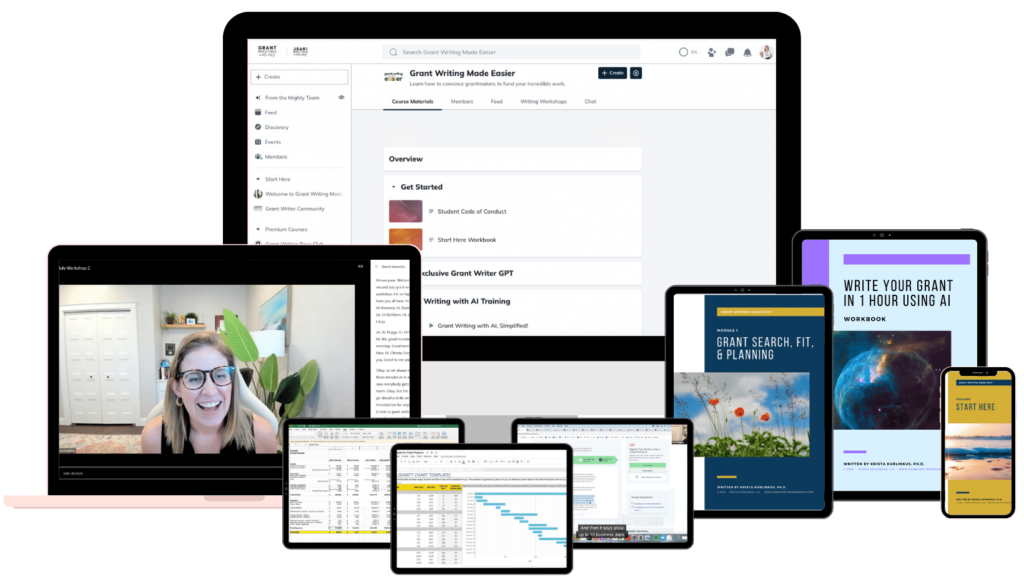
Join us at Grant Writing Made Easier, where the future of grant writing is already here, and it looks a lot like less stress and more wins.
We’d love to hear from you.
What’s your biggest question or hesitation when it comes to using AI in your grant writing process? Have you tried any tools yet, or are you still figuring out where to start? Drop your thoughts in the comments below.